When AI Replaces Thinking, the Body Becomes More Important
Artificial intelligence is rapidly transforming the world.
Systems can now write texts, compose music, generate images and assist with programming. Tasks that once required years of training are becoming increasingly automated.
This development raises an important question:
If machines can think, create and analyze faster than humans, what remains uniquely human?
The answer may lie in something that modern technology has largely ignored — the intelligence of the body.
A Form of Intelligence We Rarely Talk About
For centuries we have associated intelligence with the brain.
Schools train logical thinking.
Computers extend analytical abilities.
Most digital tools are designed around symbolic commands: clicking, typing and selecting.
But much of what makes us human does not happen through symbols.
It happens through movement, perception and interaction with the world.
Balancing while walking.
Feeling rhythm when music begins.
Adjusting posture without thinking.
Sensing subtle changes in a space.
These abilities are not calculated step by step.
They emerge naturally from the body interacting with its environment.
This form of intelligence is often described as embodied cognition.
The Body Creates Meaning
The neuroscientist and philosopher Francisco Varela described cognition not as abstract computation but as sense-making through action.
In this view, perception and movement are inseparable.
We do not first understand the world and then act.
We understand the world through acting in it.
A dancer understands music differently from someone reading notes.
A climber understands a mountain differently from someone looking at a map.
Meaning emerges through interaction.
Why This Matters in the Age of AI
Artificial intelligence excels at symbolic processing.
It can analyze text, recognize patterns in data and generate complex outputs. But these systems do not experience the world through a living body.
Humans do.
Our perception is shaped by balance, gravity, rhythm, tension, breath and movement. These subtle bodily processes constantly influence how we experience sound, space and atmosphere.
As AI becomes better at symbolic tasks, the uniquely human domain may shift toward embodied experience.
Not thinking about the world.
But being present in it.
Exploring a Different Kind of Interface
Most digital systems require us to translate our intentions into commands.
Buttons.
Menus.
Sliders.
But what if interaction did not rely on commands at all?
What if a system could simply respond to the body itself?
FanRows
FanRows explores this idea through sound.
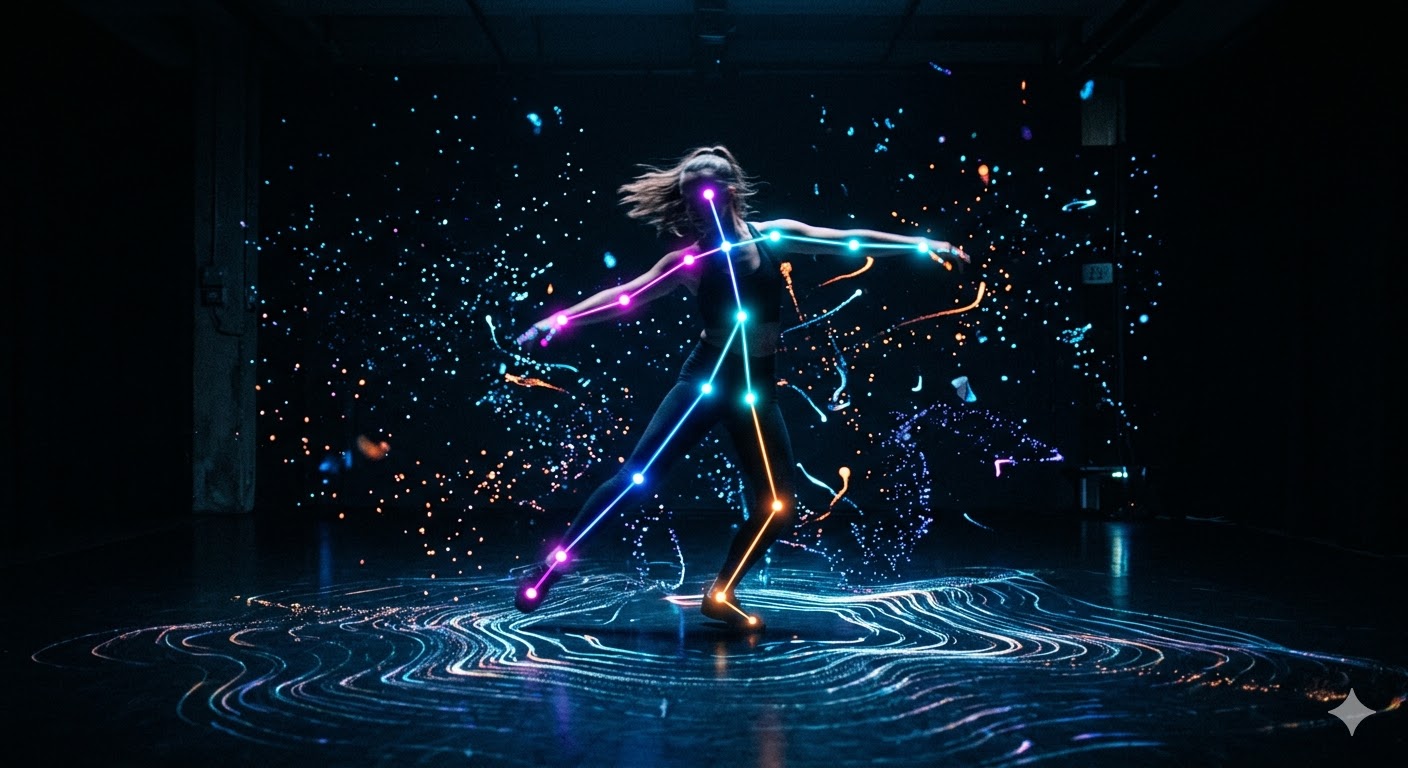
Instead of controlling music with buttons or instruments, participants move in front of a camera. The system interprets qualities of their movement — posture, stability and motion dynamics — and continuously transforms a layered sound environment.
The result is not a composition.
It is a sound space.
Participants gradually discover that their body influences the environment around them. A small shift in posture may change the atmosphere. A slow movement can reshape the entire sonic landscape.
Over time the interaction becomes less about control and more about exploration.
The body learns how the space responds.
And the sound becomes something that is inhabited rather than operated.
Rediscovering a Human Skill
In a world increasingly shaped by artificial intelligence, the most valuable human abilities may not be analytical or computational.
They may be sensory, physical and intuitive.
Abilities that arise from being a living organism in a complex environment.
FanRows is an experiment in this direction.
Not a tool for producing music, but a space where movement, perception and sound form a continuous loop.
A small reminder that some forms of intelligence do not exist in algorithms.
They exist in the living body.
Perhaps the future of human expression will not be found in better interfaces, but in rediscovering the intelligence of the body.