Concept
FanRows is built around a simple idea: sound can behave like a space rather than a sequence.
Instead of moving through a composition along a fixed timeline, a person explores relationships between body and sound. Posture, direction, velocity, stillness and duration can influence what is heard, while the changing sound becomes part of what the person perceives and responds to.
FanRows therefore does not define a fixed vocabulary of gestures. It creates conditions in which movement–sound relationships can be discovered, revisited and combined through experience.
Sound as a Space
A FanRows session is made from sound material and movement relationships that together form a particular environment. Some parts of that environment may be easy to find, while others emerge only through combinations of posture and movement.
A sound layer might gradually appear as an arm rises and change character as the elbow opens. Torso movement can alter the balance between different layers, while velocity or stillness affects other properties of the sound. Because several relationships can exist at the same time, the resulting state is shaped by the body as a whole rather than by a single command.
This makes it possible to return to a familiar area of the sound space without requiring every repetition to produce exactly the same result. The space has structure, but it remains open to exploration.
Between Influence and Openness
FanRows does not try to eliminate control. Different sound spaces can deliberately offer different degrees of influence.
In one environment, a relationship between movement and sound may be easy to understand. A participant can discover that a certain posture or movement produces an interesting result and intentionally return to it. In another environment, the relationship may be less explicit, with several mappings and slowly changing sound layers interacting at once.
Complete predictability can make an interaction mechanical. Complete unpredictability makes it difficult to develop any meaningful relationship with the system. FanRows is particularly interested in what happens between those extremes: when there is enough stability to learn and revisit relationships, but enough openness for unexpected combinations to emerge.
The balance itself can change during a session. A person may begin by deliberately shaping sound and later spend more time listening, moving intuitively or remaining still.
Body and Sound in a Loop
Movement changes sound, but the interaction does not end there. The changed sound becomes part of what the participant perceives, and that perception can influence the next movement.
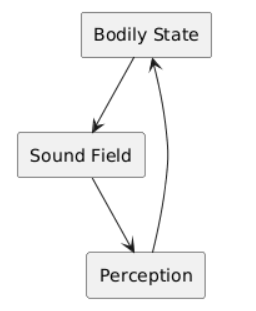
Over time, this forms a continuous body–sound loop. A movement may be repeated because the resulting sound was interesting. A posture may be held because a particular texture has emerged. A change in the sound may encourage slower movement, a different direction or a period of stillness.
The relationship therefore cannot always be reduced to a simple sequence of input and output. Movement affects sound, sound changes the perceptual situation, and the body responds again.
FanRows does not prescribe what these relationships should mean. Their significance develops through interaction.
Changing Rooms
A FanRows session can contain several scenes, but a scene does not have to behave like a new track, a preset or a conventional section of a composition.
Scenes can represent different conditions within a larger sound world. Sound material, mappings, responsiveness and the degree of openness can change while the experience itself continues. With gradual transitions, moving from one scene to another can feel less like switching between compositions and more like entering another part of the same environment.
This allows a sound space to develop over time without requiring every change to be arranged along a fixed musical timeline.
Exploration as Part of the System
FanRows is designed around the assumption that not everything needs to be understood immediately.
A participant may begin by deliberately trying movements and listening to what happens. Certain relationships become familiar through repetition, while others may first appear by accident. A sound that initially seems insignificant can become meaningful after spending time with it, and a movement may become interesting because of the sonic state that develops around it.
Exploration is therefore not simply a temporary stage before someone has learned the interface. It is part of the interaction itself.
For a creator, this changes the design question. It is no longer only what should this movement control? but also what kind of relationship should someone be able to discover here, and how much of it should remain open?
An Experimental Concept
FanRows provides a concrete environment for exploring these ideas rather than presenting them as a finished theory.
The project is informed by cybernetics, embodied cognition, perception–action research, human–computer interaction and sonic interaction design. These fields provide useful ways of thinking about feedback, adaptation and the relationship between action and perception, but FanRows is not intended as an implementation of any single theoretical model.
Its concepts are developed through actual sound spaces and through repeated interaction with them. Technical behaviour can be tested in software, while other questions only become visible when people spend time moving, listening and adapting inside the system.
The questions emerging from this work are explored further in FanRows Research →, while the technical implementation is documented in Architecture →.
FanRows — Sound as a space explored through movement.