Create sound spaces with movement
FanRows lets creators turn sound material into interactive environments shaped by the body.
Drones, textures, loops, and atmospheric layers can respond continuously to posture, movement, velocity, and stillness.
For ambient music, sound art, audiovisual work, and experimental performance.
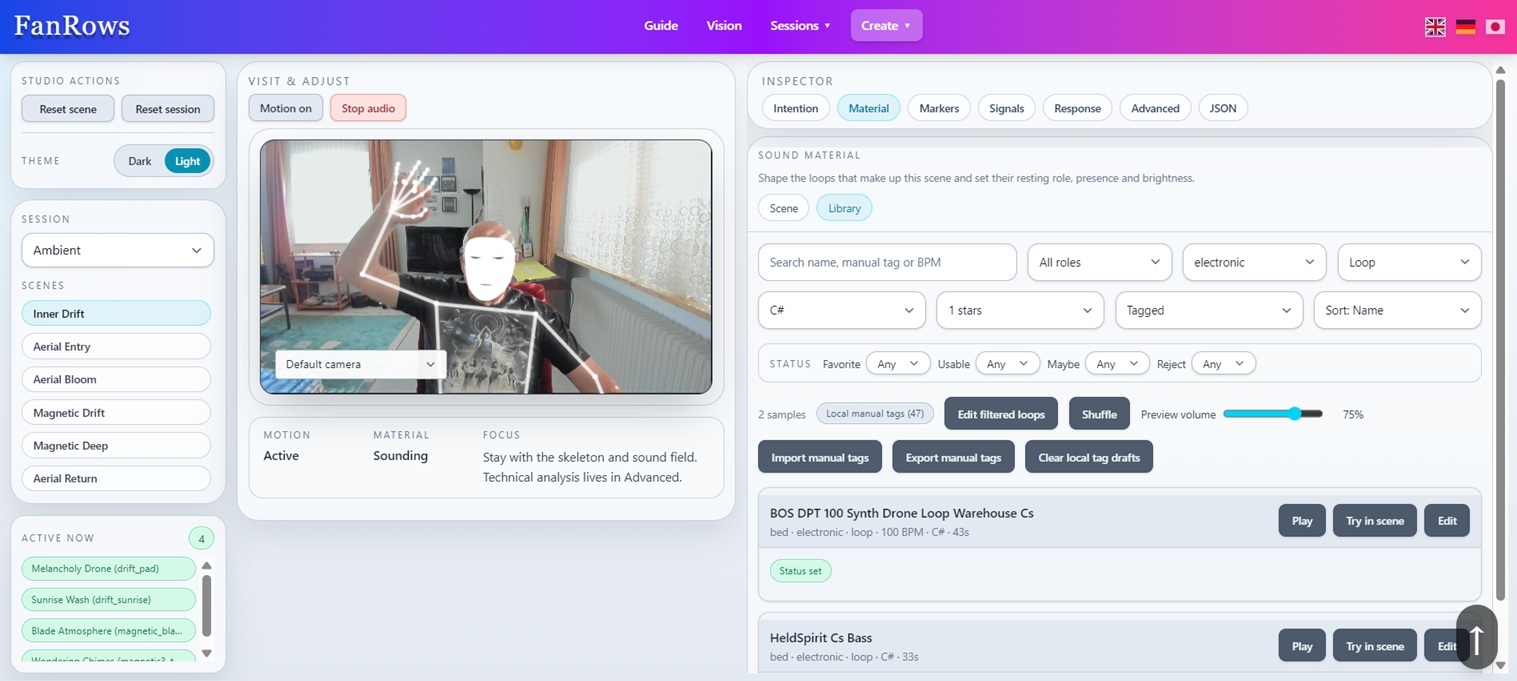 FanRows Studio — shaping an ambient sound space through body movement and layered sound.
Start a live session ↗
Requires webcam access • Chrome recommended • Laptop/desktop
Ambient music is a natural starting point for this kind of work. Producers already work with slow transformations, layered textures, drones, field recordings, filtered noise and sounds that sometimes change so gradually that the transition itself becomes part of the composition. FanRows adds another dimension to this practice by allowing some of those changes to happen through movement rather than automation alone.
A layer might gradually appear as an arm rises, while the angle of the elbow changes its spectral character. Torso movement can alter the balance between foreground and background, and body velocity can make a texture more active without simply making it louder. When several of these relationships overlap, the result is no longer a set of gesture commands. It becomes a responsive sound environment that can be explored, learned and revisited.
This is where FanRows differs from a conventional controller. The body is not reduced to a collection of virtual knobs. Shoulder and elbow angles change together, left and right sides do not have to behave symmetrically, and every movement has a starting posture, a direction, a speed and an end state. FanRows uses these relationships as continuous signals and connects them to sound.
From Studio to embodied testing
Creating a responsive sound environment is an iterative process. A mapping can be technically correct and still feel very different when experienced with the body. FanRows therefore allows creators to configure movement–sound relationships, test them immediately through movement, and return to the Studio to adjust them.
The clip shows FanRows Studio, live body tracking, adjustment of movement–sound relationships, full-body testing, body visuals, and interaction analysis during development.
From ambient production to interactive sound
A producer can begin with completely familiar material. A drone created in Ableton Live, a slowly evolving pad, a bowed texture, a field recording or a noise layer can all become part of a FanRows session. The sound itself does not need to be generated inside FanRows; what changes is the way it behaves once it becomes part of the system.
Instead of deciding only when a layer enters or leaves, the creator can decide under which bodily conditions it becomes present. A sound may gradually emerge within a certain shoulder-angle range and then change again when the elbow opens. Another layer can react to the opposite side of the body. Velocity, lean or stillness can influence how the overall sound field develops. These mappings can remain stable enough to be learned while still producing combinations that are not obvious in advance.
For ambient producers this opens a path from ambient music production and ambient sound design toward interactive ambient music and evolving soundscapes. The generative quality does not have to come from randomness. It can emerge from the changing relationship between body configuration, movement and sound.
For FanRows, a participant should be able to discover an interesting sonic state and, at least approximately, find a way back to it, while the system still leaves enough openness for something unexpected to happen when several mappings overlap.
Body tracking as part of composition
Real-time body tracking is often used as a replacement for buttons, MIDI controls or predefined gestures. FanRows can technically do those things, but that is not the main idea. The more interesting question is what happens when body tracking for sound and music becomes part of the composition itself.
MediaPipe provides continuous information about posture, joint angles and movement. FanRows turns those measurements into signals that can influence gain, filtering, texture, effects, spatial character and the balance between sound layers. Because several signals can act at once, one body configuration can create a sonic state that cannot be described by a single control value.
In that sense, body movement controls sound, but control is only one part of the relationship. Exploration is equally important. Someone can move slowly through a session, notice a change, repeat a movement, stay in a position for a while or discover that a slightly different posture produces a completely different result.
This makes the same system relevant beyond personal music production. A sound space can become an interactive sound installation in which visitors do not need to learn a gesture vocabulary before they begin. They can enter, move and listen. The relationships become understandable through experience rather than instruction.
For sound artists, this connects FanRows with interactive audio, interactive music, sound art, audiovisual performance and movement-based installations. For ambient producers, it offers a way to take material that would normally live on a timeline and turn it into an environment.
Designing what can be discovered
Creating a FanRows session changes some of the questions a producer normally asks. It is still important to choose the right material, balance the layers and shape the overall sound. But another set of questions appears alongside the musical ones: how quickly should someone understand a relationship? Should a certain texture become available only in a narrow body configuration? Should stillness reveal detail, or should it remove sound? Should the left and right sides behave differently?
These are not purely technical mapping decisions, because they directly affect how a sound space feels when somebody moves inside it.
That is why a FanRows session has to be tested with the body while it is being created. A mapping that appears elegant in FanRows Studio may feel unimportant when played. Another combination may produce an interesting state that was never conceived as a gesture at all. The creator moves, listens, repeats, adjusts and tries again. In this sense, the process is part sound design, part interaction design and part embodied exploration.
FanRows does not prescribe one musical style. Ambient music works especially well because drones, textures and slow transformations give continuous movement time to become perceptible, but the same principles can be used for very different sonic material. What matters is not whether the result belongs to a particular genre. What matters is that movement becomes part of how the sound behaves.
The longer-term idea is simple: creators build sound spaces and other people explore them. Some participants may understand a relationship immediately, while others may discover it only after several minutes. A posture can become associated with a certain atmosphere, a repeated movement can lead back to a familiar sound, and a new combination can open something that neither the creator nor the participant had explicitly planned.
FanRows is therefore not only about making music respond to the body. It is about designing environments in which sound can become understandable through bodily experience.
FanRows currently combines MediaPipe motion tracking with Web Audio, Tone.js and configurable movement-to-sound mappings in the browser. FanRows Studio is being developed as the creator environment for combining sound material, body signals and audio responses into reusable sound spaces.
Start a live session ↗
Requires webcam access • Chrome recommended • Laptop/desktop
FanRows — Create sound spaces. Explore them through movement.